

Introduction
Have you ever felt lost, broken, or simply in need of a reason to be good again? You are not alone — and that is exactly why religious motivational stories have been passed down for thousands of years across every faith tradition in India and the world.
These are not just tales from old scriptures. They are lived lessons — stories of real human struggle, divine grace, and the quiet, unstoppable power of kindness. Whether you follow Hinduism, Islam, Sikhism, Christianity, Buddhism, or Jainism, the spiritual message is almost always the same: being kind is one of the most powerful things a human being can do.
In this blog, we bring you seven deeply moving religious inspirational stories drawn from India’s rich multi-faith heritage. Each story carries a clear moral, actionable wisdom, and the kind of warmth that stays with you long after you have finished reading.
Why Religious Motivational Stories Matter
The Science and Soul Behind Storytelling
Humans have always learned best through stories. According to research published in the journal Cognitive Science, narrative-based learning increases retention by up to 65% compared to plain facts. Our minds are wired to remember a story far longer than a lecture.
But motivational thoughts about religious life stories go further than psychology. They touch something deeper — your conscience, your sense of purpose, your relationship with the divine.
Why Kindness Is the Central Theme
Across all major faiths practiced in India:
- Hinduism calls it Daya (compassion)
- Islam calls it Rahm (mercy)
- Sikhism calls it Seva (selfless service)
- Christianity calls it Agape (unconditional love)
- Buddhism calls it Karuna (compassionate action)
- Jainism calls it Ahimsa (non-harm, non-violence)
Every tradition agrees: kindness is not weakness. It is the highest form of strength.
Story 1 – The Lantern of the Poor Man (Hindu)
A Short Religious Motivational Story From the Ramayana Tradition
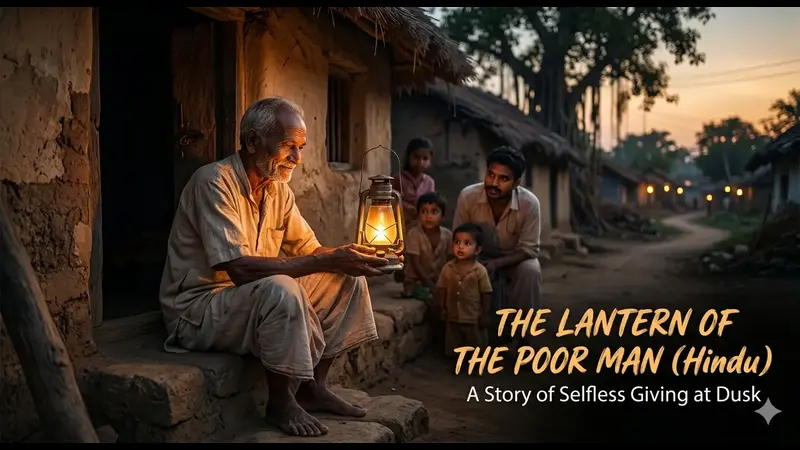
There was once a poor oil-seller in Ayodhya who could barely afford to keep his lamp lit through the night. One evening, a traveller knocked on his door — cold, hungry, and lost.
The oil-seller had only one meal left. But without a second thought, he fed the stranger, gave him his blanket, and used the last of his oil to light the man’s path forward.
His wife was upset. “We have nothing left for tomorrow,” she said.
The old man smiled. “We gave what we had tonight. Tomorrow is in God’s hands.”
The next morning, a merchant arrived at their door — the very traveller from the night before — who turned out to be a nobleman in disguise. He gifted the couple enough grain and gold to last a lifetime, but more than that, he told their village: “I have seen true dharma lived in this humble home.”
The Lesson
This short religious motivational story teaches us that genuine kindness never calculates. It gives without expecting anything in return. And dharma — righteous action — always finds a way to complete its own circle.
Key Takeaway: Do not wait until you have “enough” to be kind. Kindness does not require abundance — it requires courage.
Story 2 – The Buddhist Monk and the Scorpion
Motivational Thoughts About Religious Life Stories — From Buddhist Wisdom
A monk was meditating by a river when he noticed a scorpion drowning in the water. He reached in to save it — and was immediately stung. He tried again. Stung again.
A passerby laughed. “Fool! Why do you keep saving what keeps hurting you?”
The monk looked up calmly. “It is the scorpion’s nature to sting. It is my nature to save. Why should I abandon my nature simply because the scorpion does not abandon its own?”
The Lesson
This beautifully simple short religious motivational story carries profound depth. Kindness that is conditional on how others treat you is not really kindness — it is a transaction. True compassion, as the Buddha taught, flows from your own character, not from the character of the recipient.
Key Takeaway: Your kindness is yours. Do not surrender it to the behaviour of others.
Story 3 – The Christian Leper and the Saint
A Religious Inspirational Story from Christian Tradition
A young Francis of Assisi — before he became a saint — once encountered a leper on the road. His first instinct was to turn away in disgust and fear. But something stopped him.
He dismounted his horse. He walked to the leper. And with trembling hands, he embraced him.
When he looked up, the leper was gone. Francis later wrote in his testament that in that moment, what seemed bitter was turned into sweetness of soul and body. He believed he had embraced Christ himself.
That single act of overcoming his own repulsion became the turning point of his entire spiritual life.
The Lesson
This story is a reminder that the greatest acts of kindness often require us to conquer something within ourselves first — fear, pride, disgust, or habit. And when we do, we are often transformed more than the person we helped.
Key Takeaway: The person who needs your kindness most may be the one you find hardest to give it to.
Story 4 – The Sikh Guru and the Thief
Religious Stories for Motivation From the Sikh Tradition
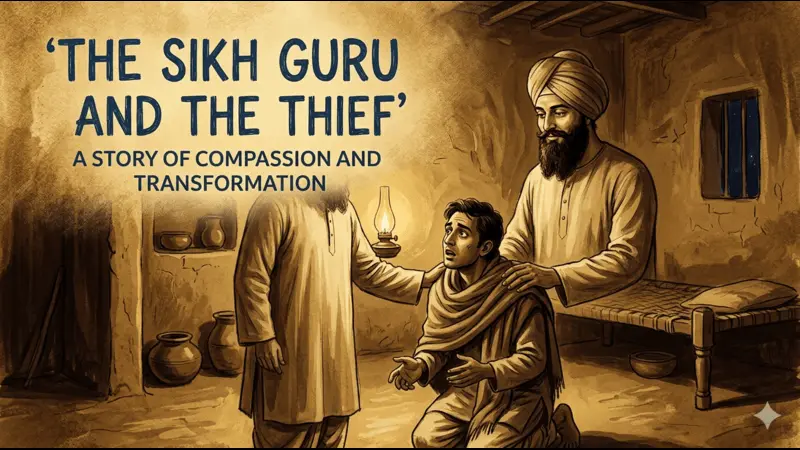
During the time of Guru Nanak Dev Ji, a notorious thief named Sajjan ran a beautiful dharamshala (inn) on the highway. He would welcome travellers with great warmth, wait until they slept, and then rob them of everything.
One day, Guru Nanak arrived at Sajjan’s inn. Sajjan treated him with the same false hospitality. Late at night, when Sajjan came to rob the sleeping Guru, he heard him singing a shabad — a sacred hymn — that described Sajjan’s own life back to him:
“The heron stands in the sacred waters, but preys upon the fish within them. The one who wears white on the outside but darkness within — God sees all.”
Sajjan froze. The words entered his chest like an arrow. He fell at the Guru’s feet, weeping.
Guru Nanak did not shout. Did not condemn. He simply said: “The thief you must catch is not outside — it is the darkness inside. Turn toward the light.”
Sajjan gave away everything he had stolen. He spent the rest of his life serving others. The dharamshala became a place of genuine welcome.
The Lesson
This religious inspirational story reminds us that kindness — even when shown to someone who does not deserve it — can be the most powerful force for change. The Guru did not punish. He illuminated.
Key Takeaway: Sometimes the kindest thing you can offer someone is the truth — delivered with love, not judgment.
Story 5 – The Jain Merchant Who Gave Everything
Religious Motivational Stories Rooted in Jainism’s Principle of Ahimsa
In ancient Gujarat, a wealthy Jain merchant heard that a nearby village was facing severe drought and famine. His advisors told him: “If we give away our stores, we will have nothing for next season.”
The merchant replied: “My grain can be replenished. Their lives cannot.”
He opened his warehouses completely — giving grain not just to Jains, but to Hindus, Muslims, and people of all faiths without discrimination. He personally supervised the distribution to ensure no one was overlooked, even walking long distances to reach the most remote families.
By the end of the season, he had almost nothing left. But the next harvest — blessed, it was said, by the gratitude of thousands — was the most abundant the region had seen in decades. The merchant’s name became synonymous with generosity for generations.
The Lesson
Jain philosophy teaches Parasparopagraho Jīvānām — “All life is bound together by mutual support and interdependence.” Kindness, in this view, is not charity. It is recognising that we are all part of one another.
Key Takeaway: Generosity extended beyond the boundaries of your own community is the truest form of ahimsa.
Story 6 – The Prophet’s Neighbour (Islamic)
A Short Religious Motivational Story From Islamic Tradition
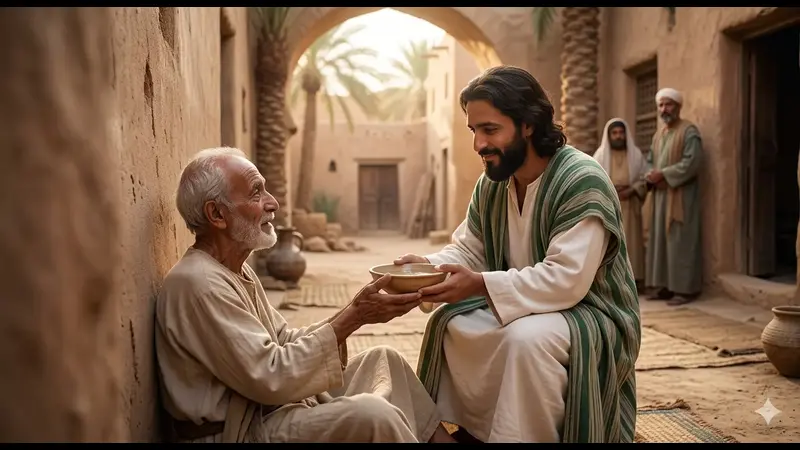
The Prophet Muhammad (PBUH) had a neighbour who deeply disliked him. Every day without fail, this neighbour would throw garbage in front of the Prophet’s door.
The Prophet said nothing. He cleaned it up. Every single day.
One morning, there was no garbage. The Prophet noticed — and instead of feeling relieved, he felt concern. He went to his neighbour’s home and found the man ill in bed, with no one caring for him.
Without hesitation, the Prophet sat beside him, brought him food, water, and medicine, and tended to him until he recovered.
The neighbour was speechless. “Why?” he asked. “After everything I did to you?”
The Prophet replied: “You are my neighbour. That is reason enough.”
The man embraced Islam — not because of any argument — but because of a kindness he could not explain.
The Lesson
Among all religious stories for motivation, this one demonstrates the most direct truth: actions of genuine kindness speak louder than any scripture, sermon, or argument. Faith lived through conduct is the most powerful form of da’wah (invitation).
Key Takeaway: You cannot always argue someone into goodness. But you can love them there.
Story 7 – The Silent Seva of a Village Woman
A Modern Religious Inspirational Story From India
This story does not come from scripture — it comes from a small village in Rajasthan, around the 1980s.
An elderly woman named Dadi Leelabai had very little. She was a widow with no children, living on the charity of her neighbours. Every morning, despite her own hunger, she would leave a small clay bowl of water outside her door for the labourers who passed on their way to the fields.
She was asked once why she did it — she could barely feed herself.
She said: “The Guru says that even a cup of water given with love is worth more than a palace given with pride. I may not have food to give — but I have water. And I have love. So I give both.”
Over the years, without any plan or announcement, this one quiet act inspired the entire village to start a community water station that eventually served thousands.
One small bowl of water. One woman’s unshakeable faith. And a ripple that changed a community.
The Lesson
You do not need resources, status, or power to practice kindness. The smallest consistent act of compassion, rooted in genuine faith, has the power to move mountains — quietly, and in its own time.
Key Takeaway: Kindness does not require grand gestures. It requires sincerity.
Common Mistakes People Make When Reading Religious Stories
Many readers consume religious motivational stories passively — as entertainment rather than as mirrors. Here are the most common mistakes to avoid:
- Treating stories as mythology, not medicine — These stories carry prescriptions for daily life. Read them as practical guides, not fairy tales.
- Comparing your religion to others — Every story here — Hindu, Muslim, Sikh, Christian, Buddhist, Jain — carries the same truth. Use them to find commonality, not superiority.
- Waiting for the “right moment” to act — Every story above shows someone who acted despite difficult circumstances. Kindness waits for nothing.
- Reading without reflecting — After each story, pause. Ask: Where in my own life does this apply right now?
- Forgetting that you are also a character in someone else’s story — Someone, somewhere, is waiting for you to be their Guru Nanak, their Prophet, their old oil-seller.
Pro Tips – How to Apply These Lessons in Daily Life
Reading short religious motivational stories is meaningful. Living them is transformative. Here is how to bridge the gap:
- Start with one small act per day. Leave water for the sweeper. Smile at the security guard. Call the relative you have been avoiding.
- Keep a “kindness journal.” Write one kind act you did and one you witnessed each evening. This trains your eyes to see goodness.
- Recite a faith-based intention in the morning. Whether it is a verse from the Quran, a Gurbani shabad, a shloka, or a prayer — anchor your day in your faith.
- When you feel wronged, ask: “What would the character in my favourite religious story do right now?”
- Share these stories. Storytelling is itself an act of service. Forward this blog, read a story to your child, or discuss it at your next family meal.
Expert Advice – What Spiritual Leaders Say About Kindness
Some of the most widely respected spiritual voices of India and the world have spoken clearly on this theme:
Sri Sri Ravi Shankar has often said that kindness is not a strategy — it is the natural expression of a mind that is free from fear.
Dalai Lama teaches that his religion is simply kindness — a statement that transcends any single tradition and speaks to the universal human heart.
Sadhguru reminds us that compassion is not about feeling sorry for others — it is about recognising that the same life force flows through all of us.
Maulana Wahiduddin Khan wrote extensively that Islam’s greatest proof is not argument but akhlaq — character — and that the Prophet’s biography is one long lesson in radical kindness.
The consensus across traditions is clear: kindness is not one value among many. It is the foundation upon which all other virtues stand.
FAQ – Frequently Asked Questions
What are religious motivational stories and why are they important?
Religious motivational stories are narratives drawn from faith traditions — scriptures, oral histories, or the lives of saints and spiritual teachers — that illustrate moral and spiritual principles through real or symbolic human experiences. They are important because they make abstract values like compassion, honesty, and selflessness tangible and relatable. For Indian audiences especially, these stories are deeply embedded in cultural identity and offer a powerful framework for ethical living.
Which religion has the most motivational stories about kindness?
Every major religion practiced in India — Hinduism, Islam, Sikhism, Christianity, Buddhism, and Jainism — has a rich treasure of religious inspirational stories centred on kindness. Rather than one tradition having “more,” each offers a unique lens. The Sikh tradition emphasises seva (service), Islam emphasises rahm (mercy), Hinduism emphasises daya (compassion), and Buddhism emphasises karuna (compassionate action). Together, they form a complete picture.
How can short religious motivational stories help children?
Short religious motivational stories are ideal for children because they communicate complex moral values through simple, memorable narratives. Children who hear these stories regularly develop stronger empathy, a sense of fairness, and respect for people of different faiths. Stories like the Buddhist monk and the scorpion or the Sikh Guru and the thief are especially powerful for young minds because they present moral dilemmas and clear resolutions.
Are motivational thoughts about religious life stories relevant in modern India?
Absolutely — perhaps more than ever. In a time of social media, fast opinions, and communal tensions, motivational thoughts about religious life stories serve as a reminder of shared human values. They cross caste, class, and religion. They remind us that our great-grandparents — of every faith — believed in the same basic human goodness. Revisiting these stories is an act of cultural healing as much as personal inspiration.
How do I use religious stories for motivation when I am going through a difficult time?
When facing hardship, choose a story whose character faced a similar challenge — loss, betrayal, poverty, illness. Read it slowly. Do not rush to the moral. Sit with the character’s pain first, then notice how they responded. Ask yourself: What one small thing can I do today that reflects the spirit of this story? Religious stories for motivation are not meant to eliminate your struggle — they are meant to show you that struggle, met with faith and kindness, has always been the path through.
Conclusion
The greatest thing about religious motivational stories is that they do not belong to any one temple, mosque, gurudwara, or church. They belong to anyone who reads them with an open heart.
Each of the seven stories in this blog carries the same whisper: kindness is never wasted. It always travels further than you can see.
Whether it is an oil-seller who gave his last meal, a monk who kept saving the scorpion, or an old widow who left a bowl of water every morning — the message is clear: you do not need to be extraordinary to change the world. You just need to be consistently, courageously kind.
Pick one story from this blog that moved you. Tonight, before you sleep, do one thing — however small — that reflects its lesson. Then share this blog with one person who might need it today.
The ripple starts with you.
Did this blog inspire you? Bookmark it, share it with family, and revisit it whenever you need a reminder of what truly matters.